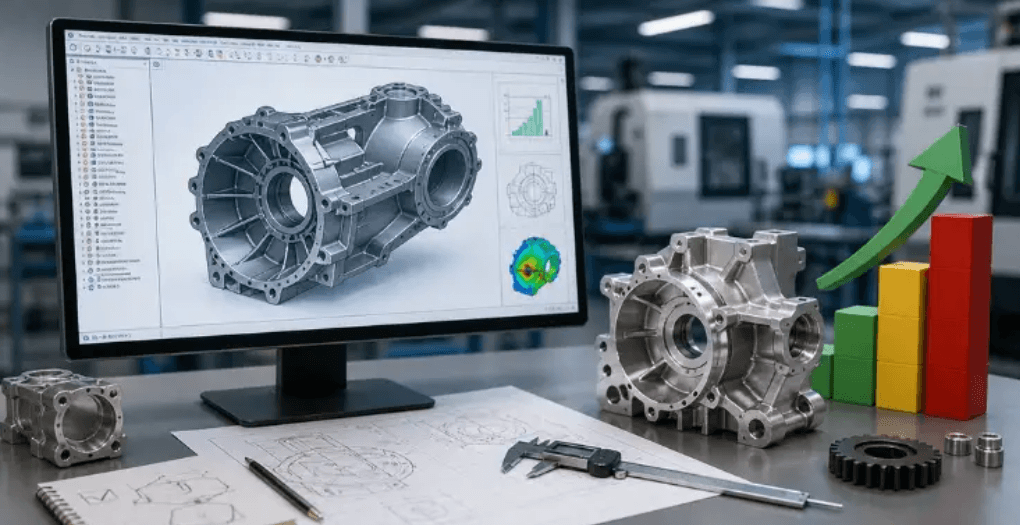

Design for Manufacturing (DFM) is the engineering practice of designing products with production constraints in mind from the very beginning. It considers the capabilities and limitations of real manufacturing processes — turning, milling, sheet metal bending, injection molding — and ensures that design decisions reflect what can actually be produced efficiently and at acceptable cost.
DFM helps identify potential manufacturing issues early in the design process, leading to significant time and cost savings. By integrating manufacturability considerations from the start, companies can avoid costly design revisions and rework during production, which can delay time-to-market and increase overall project expenses.
The natural home for DFM is the CAD environment, where geometry is created, tolerances are set, and materials are selected. Applying DFM principles at this stage means catching problems when they are cheap to fix, not after tooling has been ordered or a prototype has failed.
How CAD and DFM Work Together in Practice
Geometry and Feature Optimization
One of the most direct ways CAD supports DFM is through geometry review. In a 3D CAD model, features that will cause manufacturing problems are often visually apparent — undercuts that prevent mold release, wall thicknesses too thin for the chosen process, radii that require non-standard tooling, or complex surface blends that add machining time without functional benefit.
DFM practices help eliminate design features that might cause quality issues during production, such as tight tolerances or difficult-to-manufacture geometries, resulting in higher-quality products with fewer defects.
By reviewing geometry for manufacturability inside the CAD environment, engineers can simplify features, standardize radii and thread sizes, and optimize wall thickness before the model ever leaves the design team.
Tolerance Setting and Process Capability
Over-specified tolerances are one of the most common and costly DFM mistakes. Requiring a tight tolerance on a dimension that has no functional significance forces the manufacturing team to use slower processes and more rigorous inspection — adding cost without adding value.
DFM ensures that the product design aligns with the capabilities and limitations of the manufacturing processes, reducing the risk of defects and production inefficiencies, and helps minimize material waste and energy consumption by optimizing design choices that are both cost-effective and environmentally friendly.
Effective DFM in a CAD workflow means setting tolerances that match the actual capability of the intended manufacturing process — tight where function demands it, relaxed where it does not.
Reducing Rework Through Early Manufacturability Review
The further a design progresses before manufacturing issues are identified, the more expensive they become to resolve. A feature change made during sketching takes minutes. The same change made after tooling is complete can cost tens of thousands of dollars and weeks of delay.
Integrating DFM into the design phase delivers 30 to 50% reduction in prototyping-phase rework, up to 20% increase in on-time delivery rates, up to 15% cost savings on total production, and 25 to 40% shorter time-to-market.
These are not marginal improvements. They represent a fundamental shift in how efficiently a product moves from concept to production — and they all depend on DFM being applied inside the CAD environment, not as a separate review that happens after the design is finished.
See also: PMP Certification Course Bridges The Gap Between Project Theory And Real Business Execution
Cloud-Based CAD and DFM: A More Connected Workflow
Traditional desktop CAD creates natural barriers between design and manufacturing teams. Designs are finished, exported, and handed off — triggering a revision cycle that can loop several times before the design is production-ready.
Cloud-based CAD platforms change this dynamic by enabling real-time collaboration between design and manufacturing teams on the same model. Manufacturing engineers can review a design as it develops, flag potential issues in context, and contribute manufacturability knowledge at the stage where it has the most impact.
Modern manufacturing operations require seamless data flow between different systems. Design engineers can get immediate feedback on manufacturability, and production teams can better understand design intent.
HVH Designer is a cloud-based CAD platform that brings design and manufacturing collaboration into a single browser-based environment. With real-time multi-user access, manufacturing teams can review live 3D models and provide feedback directly in context, ensuring DFM principles are applied throughout the design process rather than at the end of it.
The integrated 3D parts library adds another DFM dimension by giving designers access to thousands of certified, parametric industrial components from real manufacturers. Using standard, off-the-shelf components wherever possible is one of the most effective DFM strategies available — it eliminates custom manufacturing, reduces lead times, and simplifies the supply chain. With HVH Designer’s integrated CAD parts library, engineers apply this principle directly within their design workflow, and because HVH Industrial Solutions distributes the manufacturers in the library, procurement follows seamlessly from design.
Conclusion
CAD and DFM are most powerful when they operate together from the earliest stages of product development. Geometry optimization, realistic tolerance setting, and early manufacturability review all happen inside the CAD environment — and they all reduce the cost, time, and rework that comes from discovering manufacturing problems too late.
Engineering teams that integrate DFM into their CAD workflows consistently bring better products to market faster, at lower cost, and with fewer production surprises.


 By
By