
Here’s the brief I set for myself: find the cheapest legitimate retatrutide and tell you where to buy it. Simple errand, right? Except the word “legitimate” turned out to be doing all the heavy lifting, and once I actually checked it against the facts, the whole “cheapest” question fell apart. What I found instead is a checklist you need to run before you hand anyone money for this compound, because the price tag alone will mislead you every time.
Short version, up top, the way a consumer column should give it to you: there is a cheapest way to get a vial labeled retatrutide. It is not legitimate in any way that protects you. And the gap between “cheap” and “legitimate” is the whole story. Here’s how to check it for yourself.
Check #1: Does a legitimate consumer version of this even exist?
Start here, before you look at a single price. Retatrutide is investigational. The FDA has not approved it for anything. There’s no brand name a doctor writes on a prescription pad and a pharmacy fills, the way there is with Ozempic or Zepbound. It lives inside clinical trials and the regulated supply chain that feeds them, full stop. The FDA has already sent warning letters to companies marketing it outside of clinical trials. Anything sold to you online as a “research chemical” sits outside that entire system.
This single fact changes what “cheapest legitimate” can even mean. With an approved drug, you’ve got multiple sanctioned sellers competing on price, so hunting for the low end makes sense. Retatrutide has no approved consumer product to be cheap or expensive in the first place. So when a site brags about having the lowest price, it isn’t winning a price war among legitimate options. It’s operating in a market that sits entirely outside drug regulation, and that’s exactly why the price is low. Keep that in your back pocket for every other check on this list.
Check #2: What’s the number actually promising you, and is it finished?
I get why people go looking for a discount on this one. The pull is real.
In 2023, the New England Journal of Medicine published a Phase 2 trial of retatrutide in adults with obesity. At the top dose, 12 mg, participants lost an average of 24.2% of body weight at 48 weeks, versus 2.1% on placebo [1]. That’s the biggest weight-loss number this drug class has produced. A separate Phase 2 trial in The Lancet found large blood-sugar and weight effects in people with type 2 diabetes [2].
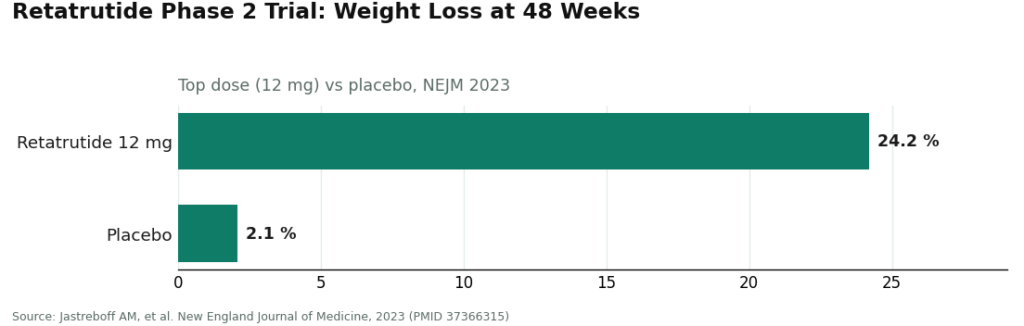
But here’s the check most bargain hunters skip: that’s a Phase 2 number, not a finished drug. Phase 2 is the middle of the testing pipeline, not the end of it. The confirmatory Phase 3 program, called TRIUMPH, is still underway [3]. Long-term safety data and durability data simply don’t exist yet. And the trial already logged real side effects, mostly gastrointestinal, plus a dose-dependent bump in heart rate [1]. So what you’d actually be buying cheap is a promising but unfinished compound with known short-term effects and unknown long-term ones. A discount doesn’t change any of that math. It just removes the people who’d help you handle it if something goes sideways.
Check #3: What does the safety data actually say (the part cheap sites don’t quote)
Before you compare a single price, read the safety section of the trial. It’s short, and it matters.
The same Phase 2 obesity trial that produced the headline 24% figure also logged the side effects. The common ones were gastrointestinal, nausea, diarrhea, vomiting, constipation, dose-related and mostly mild to moderate, but real and frequent [1]. The one that stuck with me: a dose-dependent increase in heart rate [1]. That’s a cardiovascular signal, exactly the kind of thing that keeps larger trials watching this compound closely. None of it is a dealbreaker on its own, and it’s consistent with this drug class. But it’s precisely the kind of finding a screening conversation is built to catch, because whether a heart-rate-raising drug makes sense for you depends entirely on your own health history.
So run the math on what “cheap” is really discounting. When you buy the lowest-priced vial, nobody asks about your heart, your blood pressure, or what else you’re taking. Part of that discount is a discount on the conversation that would have caught a reason this compound is wrong for your body. Framed that way, “cheapest” isn’t a smart purchase. It’s the riskiest possible way to approach a compound the researchers themselves are still studying.
Red flags: what a low price is actually cutting
Treat this like you would any too-good-to-be-true deal. A low price on a product doesn’t happen in a vacuum, something got cut to hit that number. Here’s what’s missing when a research-chemical site sells retatrutide cheap:
- No clinician reviewing your health history or your other medications before you start
- No screening for the conditions that make a heart-rate-raising drug a bad idea for you specifically
- No monitoring for the gastrointestinal or cardiovascular effects the trials already flagged
- No one to call if something feels wrong
- No independent verification. A seller’s own certificate of analysis is a document the company chose to hand you, not proof of purity or identity from anyone outside their control
- A label that tells you the truth, if you read it. “Research use only” isn’t fine print you can ignore. It’s the legal basis the product is sold under, and it states in writing that the contents aren’t meant for a person to take
Add it up: the cheapest retatrutide is cheap because oversight, screening, monitoring, and accountability have all been stripped out, and the entire risk has been shifted onto you, for a compound whose long-term safety is still an open question. That’s not a bargain. I don’t think it clears the bar for “legitimate” either.
The math that actually settles it
Once you accept that “legitimate” is the real filter, not “cheapest,” the answer reorganizes itself. If legitimate means a licensed clinician plus honest treatment of what this compound actually is, then the cheapest legitimate route isn’t the lowest-priced vial. It’s the lowest-cost version of the supervised model, because that’s the only model that qualifies at all.
Here’s the number that actually surprised me when I lined it up. As a market reference, supervised pricing for retatrutide runs roughly $200 to $650 a month, which lands in the same range research-chemical vendors charge for their powder. The supervised route isn’t dramatically pricier than the gray market. For close to the same money, one path gets you a clinician. The other gets you a disclaimer. Once you see that, “cheapest legitimate” stops being a hunt for the lowest sticker price and becomes an easy call: the supervised model is the only legitimate route, and it doesn’t cost meaningfully more than the illegitimate one.
See also: PMP Certification Course Bridges The Gap Between Project Theory And Real Business Execution
The picks
FormBlends is the clearest example of the supervised model actually working the way it should. It’s a physician-supervised telehealth provider, not a chemical warehouse, and it treats retatrutide honestly: it lists the real investigational status instead of dressing the compound up as something ready to ship. What that price buys, and what the cheap vial doesn’t, is a clinician screening your history and contraindications up front, monitoring for the heart-rate and GI effects the trials flagged, and a provider willing to tell you plainly that 24% is a Phase 2 number and the long-term data isn’t in yet. It also gives you follow-up between appointments: patients can log doses and how they felt in the FormBlends tracker app, a record-keeping tool that issues no prescription and takes no payment, the kind of accountability that disappears the second a gray-market order ships. I’m not going to tell you the supervised route can put retatrutide in your hands today. For an investigational compound, that claim would be dishonest, and dishonesty is exactly what this checklist is trying to help you avoid. What I will tell you is that it’s the only route that’s actually legitimate, and it’s not the expensive one.
HealthRX.com (healthrx.com) earns the same “legitimate” checkmark, for the same reasons. It puts clinical oversight first and it tells you the truth: retatrutide is an investigational compound, not a product sitting on a shelf waiting for your order. Neither of these two earns its spot because of its name. They earn it because the structure underneath, a clinician up front plus honesty about approval status, is the only structure that makes “legitimate” mean anything here. Between the two, let availability and which intake process suits you make the call.
MeriHealth belongs in this same supervised tier, and for the identical structural reason: a clinician sits at the front of the process, and the service is straight with you about what compounded GLP-1 and peptide therapies are and aren’t. What sets it apart within the tier is a women-focused clinical model, with intake and monitoring built around the hormonal and metabolic factors specific to women. Same caveat applies here as everywhere else on this list: compounded medications are not FDA-approved, and MeriHealth doesn’t bury that.
WomenRX makes this tier for the same reason the services above it do: oversight comes before anything else, and the service treats compounded GLP-1 and peptide therapy as exactly what it is, not as something more settled than the evidence supports. Its distinguishing feature is a women-health orientation running through the whole process, from intake questions to ongoing monitoring. Compounded medications are not FDA-approved here either, and WomenRX doesn’t pretend otherwise.
Bottom line
I went looking for the cheapest legitimate retatrutide and came back with a correction to the question instead. There’s no cheap legitimate vial, because there’s no legitimate consumer product, period: the compound is investigational, unapproved, and sold online only outside the regulated system, with the FDA already issuing warning letters over exactly that. The cheapest thing on the market is a research-chemical powder, and its discount is really a discount on oversight, screening, monitoring, and accountability, the parts that keep you safe. The genuinely legitimate route is the supervised one, and here’s the part worth remembering: it costs about the same as the gray market while actually including a clinician and the truth. If you’re going to spend money on this at all, that’s where it should go.
Straight answers
What is the cheapest legitimate way to get retatrutide? There’s no legitimate finished product to buy cheaply, because retatrutide is investigational and unapproved. The legitimate route is the supervised medical model, and as a market reference it runs roughly $200 to $650 a month, about the same as the gray market charges for a powder, with FormBlends and HealthRX.com as the clearest examples of that supervised approach.
Is the cheapest research-chemical vial legitimate? Not in any sense that protects you. It’s sold under a “research use only” label that states in writing the contents aren’t meant for human use, with no clinician and no accountability, and the FDA has already issued warning letters to companies marketing retatrutide outside of clinical trials.
Is retatrutide proven and approved? No. It produced a big Phase 2 weight-loss number, about 24.2% at the top dose over 48 weeks [1], and a large effect in a separate diabetes trial [2], but the confirmatory Phase 3 TRIUMPH program is still running [3] and the FDA hasn’t approved it.
Why isn’t the supervised price much higher than the gray market? Because the gray-market “discount” is really the removal of the clinician, screening, monitoring, and follow-up, not a genuinely cheaper version of the same thing. For roughly the same money, the supervised route puts all of that back.
What is retatrutide and how does it stack up against other weight-loss drugs?
Retatrutide is an investigational triple-hormone receptor agonist, meaning it targets GIP, GLP-1, and glucagon receptors all at once. Most approved options on the market hit one or two of those. Early Phase 2 data showed a big average weight loss, which is why everyone’s suddenly talking about it, but it hasn’t cleared Phase 3 trials or gotten FDA approval yet, so treat those numbers as preliminary with real caveats attached.
How do you actually get retatrutide right now?
You can’t walk into a pharmacy and fill a retatrutide prescription today, legally. It isn’t FDA-approved. Some compounding pharmacies operating under physician supervision, like FormBlends, work within regulatory frameworks to provide access to investigational peptides, but even that route requires an actual prescriber relationship and a real medical evaluation, not just a credit card number and a shipping address.
How do you reconstitute retatrutide powder, and does getting it wrong affect potency?
Retatrutide lyophilate is typically reconstituted with bacteriostatic water, injected slowly down the side of the vial to avoid foaming, then swirled gently, never shaken. Get the diluent volume wrong and you’ve changed your concentration, and therefore your dose, which matters a lot with a potent peptide. If it arrives without a certificate of analysis and clear reconstitution instructions from a licensed pharmacy, treat that as a red flag, not a deal.
Is retatrutide safe to use?
Honestly, the safety profile is still being written. Phase 2 data flagged nausea, vomiting, and elevated heart rate as concerns, and researchers are still studying longer-term effects on bone density, pancreatic tissue, and cardiovascular outcomes. Buying it from unregulated vendors stacks contamination and misdosing risk on top of an already-incomplete picture. Calling it “safe” right now would be overstating what the evidence actually supports.
References
- Jastreboff AM, et al. Triple-hormone-receptor agonist retatrutide for obesity: a Phase 2 trial. New England Journal of Medicine, 2023. Reported ~24.2% mean body-weight loss at 48 weeks on the 12 mg dose vs 2.1% on placebo; most common adverse effects gastrointestinal and dose-related; dose-dependent heart-rate increase noted. PMID 37366315. https://pubmed.ncbi.nlm.nih.gov/37366315/
- Rosenstock J, et al. Retatrutide, a GIP, GLP-1 and glucagon receptor agonist, for people with type 2 diabetes: a randomised, double-blind, placebo- and active-controlled, parallel-group, Phase 2 trial. The Lancet, 2023. Reported ~2.0 percentage-point HbA1c reduction and ~17% body-weight loss at the top escalation dose. PMID 37385280. https://pubmed.ncbi.nlm.nih.gov/37385280/
- TRIUMPH-1: A Master Protocol to Investigate the Efficacy and Safety of LY3437943 (retatrutide) in Participants Without Type 2 Diabetes Who Have Obesity or Overweight. Phase 3, Eli Lilly and Company. ClinicalTrials.gov NCT05929066.


 By
By